


ROI of SEO: How to Measure SEO ROI?

Maryna Semeniuk
Author
Head of Marketing
Maryna Semeniuk
Pavlo Famuliak
Fact cheked
Co-founder
Head of SEO
Pavlo Famuliak
Fact cheked
Publication date: 14.01.2025
Updated: 03.02.2025
Reading time: 11 minutes
2791
Post_hero_bg
Home
Balance
Laptop

ROI of SEO:

In the fast world of digital marketing, measuring the ROI of SEO is critical. As businesses increasingly shift their focus to online presence, need to understand how SEO efforts translate into profit. The challenge lies not only in driving traffic but in converting that traffic into measurable business outcomes. Calculating SEO return on investment allows businesses to assess the effectiveness of their digital strategies, allocate resources efficiently, and optimize their approach for higher returns. In this blog, we’ll explore key metrics and methodologies that can help you accurately measure SEO success and ensure that every effort is contributing to your business’s bottom line. Whether you’re new to SEO or a seasoned professional, mastering this metric will empower you to make data-driven decisions that accelerate growth and success.

What Is the ROI of SEO?

The ROI (Return on Investment) of SEO is the value returned from your search engine optimization efforts in terms of revenue and growth, in comparison to the costs incurred to implement those efforts. It is a key metric that helps businesses measure how effectively their SEO strategies drive profitable results. This helps companies understand the worth of their investment in SEO and hence will lead them to make sure that efforts put into it will contribute to business growth and increased visibility.

Why Measure SEO ROI?

Measuring SEO ROI is essential for a few reasons:

  • Better clarity

    It gives a clear view of how SEO activities are affecting your business’s revenue.

  • Justification of investment

    SEO usually requires continuous resources and effort. Measuring its ROI justifies the investment by illustrating tangible results that it brings.

  • Refining strategies

    You can refine your tactics by tracking, allocating resources more efficiently, and optimizing performance for better long-term success.

What’s a Good SEO ROI?

A good ROI SEO varies across industries, business types, and levels of competition. However, a general benchmark for a strong SEO return is an ROI ratio of 5:1 or higher. This means that for every $1 spent on SEO, the business generates $5 in return. A higher ROI is an indication of well-executed SEO strategies. The goal is to continually optimize your SEO approach to exceed this benchmark, ensuring long-term profitability and growth.

How to Measure SEO ROI?

1. Calculate SEO Investment
  • Team Costs
  • Tool Costs
  • Content Creation/Syndication
  • Link Building
  • Technical SEO and Website Maintenance
2. Track Organic Traffic Conversions
  • Number of SQLs / Subscriptions / Sent Requests
  • Revenue
  • Lead Value
3. Understand Assisted Conversions

To measure SEO ROI effectively, start by calculating your SEO investment, covering costs like team salaries, tools, content creation, and link-building. Then, assess revenue from organic traffic – the number of SQLs /subscriptions/contracts, revenue per contract, and all revenue from SEO.

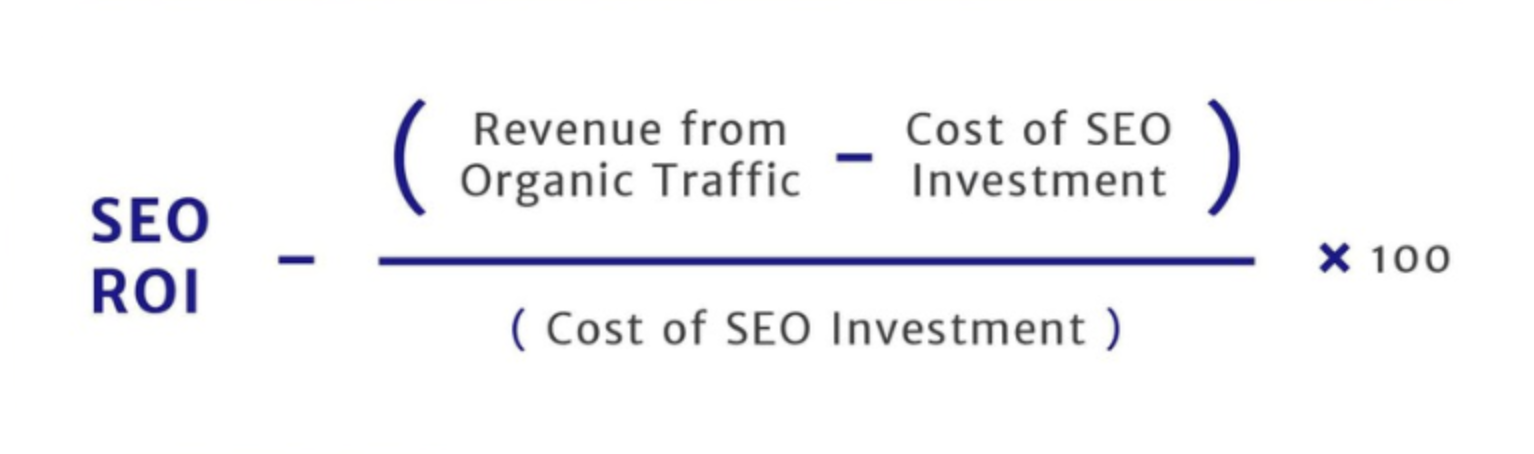
Finally, utilize the SEO ROI formula:

SEO ROI = (Revenue from Organic Traffic – SEO Investment) / SEO Investment

SEO ROI Formula

SEO ROI Formula

This formula has several advantages for the business owner, as it determines the profit made on every dollar spent on SEO. It measures revenues coming from organic traffic compared to the overall investment made in all SEO efforts – it provides absolute clarity on how effective the optimization strategy has been.

  • 1. Calculate SEO Investment

    First, you should begin by calculating your total SEO investment; which will include several components such as:

  • Team Costs:

    This is the cost associated either with your in-house SEO team or with your hired SEO agency.

  • Tool Costs:

    Running an effective SEO strategy involves investment in tools such as Ahrefs, SE Ranking, etc. which will help with keyword research, analytics, and performance tracking. Add the subscription cost of these tools.

  • Content Creation/Syndication:

    At the heart of SEO success is quality content. Add content creation, optimization, and distribution costs.

  • Link Building:

    High-quality backlinks are an important acquisition for SEO. Consider the cost of outreach, partnerships, and other link-building services.

  • Technical SEO and Website Maintenance:

    Ensure that your website is optimized for search engines. Consider the costs for developer’s work, and ongoing website maintenance.

  • 2. Track Organic Traffic Conversions

    Once you’ve set up your SEO strategies, it’s time to measure the outcomes. Conversions (the desired actions taken by visitors) are crucial to calculating your ROI on SEO. You can track conversions in the following ways:

  • Number of SQLs / Subscriptions / Sent Requests:

    This is the number of visitors who take a desired action such as making a purchase or filling out a contact form. Important to understand the relevance and quality of leads.

  • Revenue:

    Revenue is a key metric that determines how much money your business generates from this channel. This helps understand the efficiency of SEO for your business.

  • Lead Value:

    For B2B companies, understanding the value of leads generated through SEO is crucial. You can estimate the revenue each client generates for your company based on their lifetime value (LTV).

  • 3. Understand Assisted Conversions

    Assisted conversions refer to instances where SEO contributes to the process of conversion but isn’t the last step. By monitoring assisted conversions, you get a better perspective of SEO’s impact across the customer journey in its entirety. Such holistic thinking helps you grasp how your SEO efforts are supportive of conversions, even when they aren’t the last interaction before the final purchase or action.

SEO Metrics to Monitor for ROI

  • 1 Organic Traffic
  • 2 Conversions and Leads
  • 3 SEO Revenue
  • 4 Customer Lifetime Value (LTV)
  • 5 Customer Acquisition Cost (CAC)
  • Organic Traffic

    Organic traffic is a critical SEO KPI as it indicates how many relevant visitors are arriving on your website through organic search results. A strong SEO strategy helps generate consistent, long-term traffic that converts.
    Track and compare traffic on a month-by-month basis. It’s important to break down all traffic into two categories: commercial traffic (with transactional intent directed to landing pages) and informational traffic.

  • Conversions and Leads

    Tracking conversions—whether sales, form submissions, or sign-ups—is essential for calculating the direct impact of SEO on your business. These actions indicate how well your website turns organic visitors into customers or leads. Additionally, tracking lead generation gives B2B companies a clearer picture of how well SEO is contributing to long-term revenue growth.

  • SEO Revenue

    Measuring this metric helps evaluate how well your SEO efforts are converting into company profit. Well-optimized content can sustain high rankings for years, offering consistent revenue without the recurring costs of paid advertising. This makes SEO a cost-effective strategy for driving long-term business growth.

  • Customer Lifetime Value (LTV)

    LTV refers to the value a customer will create for your business throughout their relationship with you. Search engine optimization can boost your LTV by bringing quality, high-intent visitors who will be returning customers​.

  • Customer Acquisition Cost (CAC)

    CAC is the cost of earning a new customer. SEO plays a powerful role in reducing CAC considerably compared to paid channels, for it attracts organic traffic, which is more likely to convert at a lower upfront cost. Tracking these costs lets you optimize marketing budgets and focus on the most cost-effective strategies.

Need SEO Expert Advice?

Stop wasting time and money on inefficient SEO strategies. Contact us for the best result!

Challenges of Calculating SEO ROI

  • 1 Time Lag in Results
  • 2 Attribution Issues
  • 3 Branded vs. Non-Branded Traffic
  • 4 Difficult Measure SEO Impact on Retention
  • 1. Time Lag in Results

    SEO is inherently a long-term strategy. Unlike paid advertising, where results are almost immediate, SEO can take months to show noticeable effects. Ranking on Google can range anywhere from 3-6 months or longer. Because of this delay, calculating the exact ROI of SEO efforts in the short term can be difficult. The key to overcoming this challenge is to maintain consistent monitoring of traffic and conversions over extended periods. Tracking long-term trends and comparing month-over-month or year-over-year performance will give you a more accurate picture of ROI.

  • 2. Attribution Issues

    Customers may be interacting with your brand through multiple channels – SEO, paid ads, email marketing, and social media, before converting. That makes it difficult to attribute conversions solely to SEO efforts. According to Google Analytics data, users typically interact with multiple touchpoints before making a final decision. To account for this, multi-channel attribution models can be used by a business to show the value of each touchpoint throughout a customer’s journey. It gives a more holistic view of SEO in the overall marketing funnel and provides a more accurate ROI calculation.

  • 3. Branded vs. Non-Branded Traffic

    It’s important to decompose branded traffic or searches that relate to your company name, and non-branded traffic, or searches that relate to product or service. For many businesses, a large volume of traffic indeed comes from branded searches. This is not necessarily indicative of SEO performance. Branded traffic often skews results because it may be coming from loyal customers or prior SEO campaigns. For more accurate ROI measurement, focus more on non-branded traffic, which reflects the outcome of your SEO efforts in reaching new customers. By monitoring non-branded search traffic, you can assess how well your content and keywords are attracting fresh leads.

  • 4. Difficulty in Measuring SEO’s Impact on Retention

    While SEO primarily deals with acquisition, the content you develop can also be an integral part of customer retention. Engaging blog posts, informative articles, and resources can attract repeat visits, build loyalty. Measuring how SEO directly impacts retention is quite difficult, though. Customer surveys can provide helpful insights into how content from SEO efforts influences decision-making. Other key indicators are the retention metrics: repeat visits, time spent on site, and bounce rates.


    Note: Retaining a customer can be 5–25 times cheaper than acquiring a new one.

How to Calculate SEO ROI: Example

Understanding how to calculate the SEO’s ROI can be tricky, but real-world examples can provide clarity.
Let’s explore case study to better illustrate the process.

Example:

Investment in SEO: $10,000 (including team, tools, and content)
Relevant Traffic from SEO: 3,000 visits/month
Traffic to SQL (Conversion): 1%
Leads generated (SQL): 30
SQL to Contract (Conversion): 10%
Contract: 3
Average Deal Size: $25,000

ROI Calculation:
Revenue from SEO: 3 contracts * $25,000 = $75,000
ROI: ($75,000 – $10,000) / $10,000 = 6.5 : 1

Improve Your SEO ROI with Octopus Agency

At Octopus Agency, we’re aware that high metrics will eventually drive business in the long run. Thus, we create customized SEO strategies for your company that would help in enhancing visibility and converting organic traffic into revenue.

If you’re ready to improve your ROI and make your digital marketing efforts truly pay off, get in touch with Octopus Agency today! Let us help you transform your online presence into a powerhouse of growth and success.

Conclusion

Tracking and measuring SEO return on investment is crucial for understanding the impact of your digital marketing efforts and ensuring that your strategies are driving meaningful results.
As SEO is a long-term investment, continuous monitoring and optimization are necessary to achieve sustainable growth. How to measure SEO ROI involves focusing on relevant traffic, improving conversion rates, and utilizing data-driven insights.
Start measuring today and take actionable steps toward optimizing your digital strategy for even greater success.

FAQ

  • Does SEO Have a High ROI?

    Yes, SEO can have a high ROI, especially when executed strategically. SEO is one of the most cost-effective digital marketing strategies, as it drives organic traffic, enhances visibility, and contributes to conversions. The key to maximizing ROI lies in creating a tailored strategy aligned with your business goals and constantly optimizing your approach in response to the evolving digital landscape.

  • How Do You Show ROI for SEO?

    To show ROI for SEO, you should calculate the revenue generated from organic search and compare it to the total investment in SEO efforts. This calculation gives a clear picture of the return on investment. Tools like Google Analytics allow you to track organic traffic, conversion rates, and revenue generated from SEO efforts.

  • When Should I Measure SEO’s ROI?

    The ROI of SEO should be measured on a regular basis, preferably quarterly. Regular measurement allows businesses to track progress, make adjustments, and optimize strategies for better outcomes. Businesses that track ROI regularly are more likely to increase their conversion rates. Measuring every few months lets you identify trends, stay ahead of the competition, and fine-tune your approach to maximize growth opportunities.

  • How Long Does It Take to See ROI from SEO?

    SEO is a long-term strategy, and the timeframe to see significant ROI can vary. For statistics, it can take 3 to 6 months to notice measurable results from SEO efforts, though this depends on the industry and competition, but achieving your full potential may take 12 months or longer.

  • How to Forecast SEO ROI?

    To forecast SEO ROI, you should analyze competitors, niches, and historical data from previous SEO campaigns, set realistic goals, and consider industry trends. Tools like Google Search Console offer valuable data to predict potential outcomes based on past performance. Businesses that effectively forecast their SEO efforts have better control over resource allocation, which helps them remain competitive.

  • What Is the Average ROI of SEO?

    The average SEO’s ROI can vary by industry, but a 5:1 return is considered excellent. This means that for every dollar spent on SEO, businesses can expect to generate five dollars in return. Industry-specific factors, like competition, audience size, and SEO maturity, play a significant role in determining your ROI.

GET COMMERCIAL PROPOSAL

Stop wasting time and money on ineffective SEO teams. Contact us for the best results!

Політика конфіденційності(Required)
I accept the terms and conditions privacy policy
Get an offer       Get an offer       Get an offer

Blog

Similar articles

Articles_5

How Long Does SEO Take to Work? [+ Tips for Faster Results]

Maryna Semeniuk 21.05.2025

With the current fast-moving digital marketing times, knowing how long SEO lasts to kick in will allow you to have the right expectations and come up with a good strategy. As exciting as the thought of overnight success may be, SEO is something that demands patience, precision, a ...

Articles_6

Marketing Strategies for Fintech Startups and Midsize Business

Maryna Semeniuk 03.04.2025

Innovation is driving progress in this changing fintech financial landscape, and thus, a sound marketing strategy is not an advantage but a prerequisite. Fintech marketing is in a state of radical transformation, backed by the speed of technology growth and shifting consumer aspi ...

Articles_4

How To Rank In ChatGPT: Best Practices 2025

Maryna Semeniuk 07.03.2025

ChatGPT has emerged as a mighty force, transforming how users receive and interact with information. Generating free traffic from Chat GPT is one of the high-potential b2b marketing channels in 2025. This guide provi ...

Articles_2

All-in-one Guide to B2B Marketing Funnels

Maryna Semeniuk 03.03.2025

The marketing funnel is not merely a strategy's path to success, attracting prospects. While businesses continue seeking to reach other businesses, developing an understanding and creating a B2B marketing funnel will transform one's approach: ensure high conversion rates and soli ...

Articles_1

22 Common SEO Issues And How to Fix Them

Maryna Semeniuk 20.02.2025

Navigating the myriad of SEO issues can be intimidating to businesses that are just starting or without technical expertise. Businesses need to change their strategies with every update the search engines are releasing on their algorithm updates and changes in user behavior. ...

Articles_6

How to Rank in AI Search Results Effective Strategies 2025

Maryna Semeniuk 19.02.2025

Nowadays traffic from AI search/assistants is no longer a privilege but a matter of survival and growth. As AI search engines continue to redefine how information is accessed and consumed, mastering AI search SEO becomes pivotal for businesses aiming to maintain visibility and re ...

Articles_4

Web3 Marketing: The Complete 2025 Guide

Maryna Semeniuk 18.02.2025

Web3 is digital revolution, it is a paradigm shift that will finally give consumers and brands their rightful due. This guide will go deep into details: strategies, benefits, and challenges for blokchain projects. The potential of Web3 is immense; the unparalleled opportunities i ...

Articles_3

B2B Marketing Trends You Need to Know in 2025

Maryna Semeniuk 13.02.2025

B2B marketing in 2025 is marked by rapid development and moving toward personalization and technology. Digital transformation has brought businesses together with their respective audiences in a way never experienced through customer-centric approaches and state-of-the-art techno ...

Articles_5

10 Best B2B Marketing Channels to Boost Your Revenue

Maryna Semeniuk 12.02.2025

For B2B marketing channels, staying ahead of the curve is essential for driving revenue and maintaining a competitive edge. In 2025, a few channels will be especially potent in reaching and engaging business audiences. This article delves into the top 10 B2B marketing channels, t ...

Articles_4

Web3 Community: A Comprehensive Guide 2025

Maryna Semeniuk 11.02.2025

Welcome to the future of digital interaction, whereby a Web3 community is in itself a living and breathing paradigm of decentralization, transparency, and, ultimately, a user-empowering force. By the beginning of 2025, the Web3 ecosystem has turned into one of the cornerstones of ...